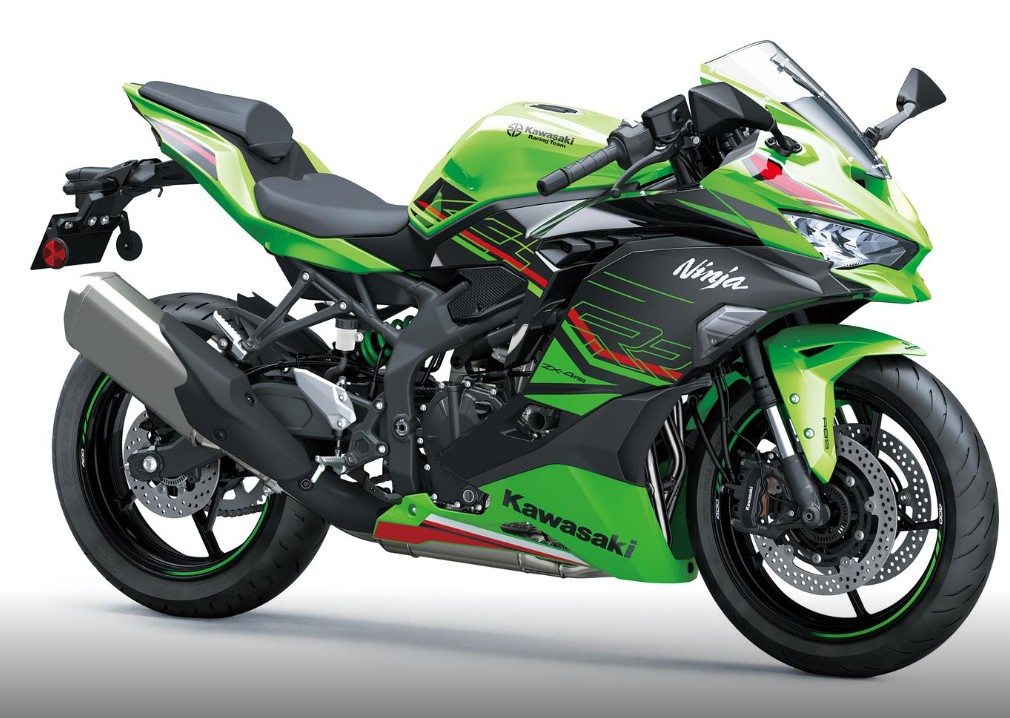
Kawasaki Ninja ZX-4R - Basic Information
Manufacturer: Kawasaki
Model: Ninja ZX-4R
Introduced: 2023 onward. Wikipedia+2kawasaki.eu+2
Category: Supersport / sport bike with a 399 cc in-line four-cylinder engine. webBikeWorld+2Wikipedia+2
Technical Specifications (2025 / Europe)
Engine & Performance
Engine type: Liquid-cooled, 4-stroke, in-line four-cylinder, DOHC, 16 valves
Displacement: 399 cc.
Bore × Stroke: 57.0 × 39.1 mm.
Compression Ratio: ~12.3 :1.
Max Power: ~57 kW (≈77 PS) at 14,500 rpm.
Max Torque: ~39 Nm at around 13,000 rpm.
Transmission: 6-speed manual, chain drive.
Chassis, Suspension & Brakes
Frame: Trellis / high-tensile steel frame. torquepedia.com+1
Front Suspension: Inverted fork (37 mm SFF-BP) with ~120 mm travel
Rear Suspension: Horizontal Back-link, gas-charged shock, ~112 mm travel.
Brakes (Front): Dual 290 mm semi-floating discs with radial-mount 4-piston calipers.
Brakes (Rear): Single 220 mm disc
Tyres: Front 120/70 ZR17, Rear 160/60 ZR17
Dimensions & Weight
Overall Length × Width × Height: ~1,990 × 765 × 1,110 mm.
Wheelbase: ~1,380 mm. kawasaki.co.th
Seat Height: ~800 mm. kawasaki.sk
Ground Clearance: ~135 mm. kawasaki.eu
Fuel Tank Capacity: ~15 litres. webBikeWorld
Curb/Wet Weight: ~188-189 kg. kawasaki.co.th+1
Overview & Character
The Ninja ZX-4R is Kawasaki’s offering in the 400cc supersport class but with a high-revving in-line four engine, a layout usually seen in larger displacement bikes. It aims to deliver a very sporty ride, both for street and track use, with a compact chassis inspired by Kawasaki’s higher sport models. Key features include strong performance for its displacement, sharp handling geometry, and modern electronics (traction control, multiple power modes, ABS) in certain markets.
Pros:
Unique in-line four engine in a ~400 cc class — gives higher revs and distinctive character. Sharp sport-bike handling and premium chassis components (relative to its class).
Cons:
High performance means it’s possibly more demanding for less experienced riders. Seat height and sport geometry may be less comfortable for longer everyday touring.
Smaller fuel tank (~15 L) relative to some more touring-oriented bikes. Weight (~188 kg) is decent for the class but still substantial for a “400 cc” category machine.
